Acadia National Park
About the park

While the Northeast contains few parks compared to other regions of the country, Acadia remains one of the most popular, with people drawn to the varied landscapes where rocky peaks overlook the Atlantic coastline. Known as 'The Crown Jewel of the North Atlantic Coast', Acadia was the first National Park east of the Mississippi when originally established as Lafayette NP, being renamed 10 years later. It was around this time that Acadia became a popular holiday destination, particularly for people from the busier cities of the Eastern seaboard, like New York, Boston and Washington D.C. However, a large wildfire in 1947 burnt more than 10,000 acres of Acadia NP, luxury hotels, and hundreds of homes.
Much of the park is situated on Mount Desert Island, site of the tallest point of the park - Cadillac Mountain. Here you can be the first to see sunrise in the USA between October 7th and March 6th. Beautiful views of Frenchman Bay, and the Porcupine islands dotted within it, await you. At the base of Cadillac Mountain is Bar Harbor, a quaint town which provides plenty of opportunity to try one of the regions specialities, Maine lobster.
The 27-mile Park Loop Road circles the majority of the park on Mount Desert Island, providing access to rocky headlands, beaches, trails and lakes. Canoeing and kayaking on these lakes and on the sea are popular activities, although the Atlantic does remain crisp even during the summer months. Despite this, Acadia provides a welcome escape from a mostly hectic Northeast, offering a glimpse into what the region was like when inhabited by Native Americans 12,000 years ago.
Our website relies on donations and affiliate links. If you click a link taking you to another website, and make a purchase, we may gain a small commission - at absolutely no cost to you. This helps us expand the website, so we can continue doing what we love!


Can't miss
View from Cadillac Mountain
The tallest mountain in Acadia National Park, at 1,530ft (466m), has a pink-tinted granite summit which is one of the first places in America to see sunrise each day. You can choose to hike to the summit, or use the paved road, giving views over Frenchman Bay and the Porcupine Islands, as well as the small town of Bar Harbor.

Beehive and Precipice trails
Two of the most famous trails in Acadia, these ascents are more akin to climbs than your typical hike. Iron rungs are used to climb large portions, with no special climbing gear required. These hikes should be greatly respected and are often slippery given the frequent mist and rain. But both provide exciting experiences, plus offer great views!

Crashing waves at Thunder Hole
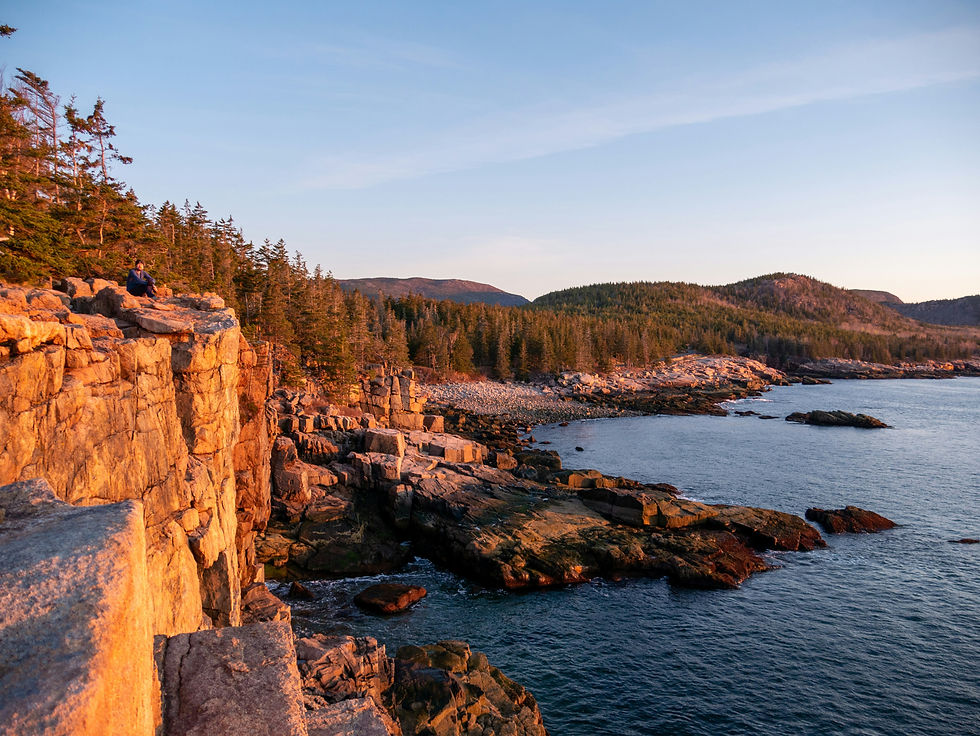
Just off the Park Loop Road, Thunder Hole is named after the sound made when the waves crash and compress the air against the rocks, spouting the water high into the air. From the rocky outcrop you can also see Otter Cliff and a less visited slice of the park, Schoodic Peninsula.

Explore the park

Click to expand


Points of interest
Bar Harbor
Bass Harbor Head Lighthouse
Cadillac Mountain
Jordan Pond
Trails

Gentle
Ship Harbor Trail
Ship Harbor Trailhead
Length (roundtrip): 1.3 miles
Approximate duration: 30-60 mins
Maximum elevation: 40 ft
Max-Min elevation change: 40 ft
This short hike is located on the south side of Mount Desert Island, and is shaped in a figure of eight, giving equal time walking along the shoreline and rock pools as within the forested sections. The trail is frequently populated by a variety of birds, including great blue herons and occasionally ospreys.
The first half a mile of the route is formed of gravel, making it easily accessible. After this point it gets slightly more uneven, with more rocks, tree roots and small steps, but is still more than suitable for the majority of visitors.
While not the most dramatic of hikes in Acadia, Ship Harbor is a very pretty inlet and it is nice to get close to the water as it laps against the rocks. For those looking for a slightly longer walk, you could combine this trail with the Wonderland trail by hiking east around the bay, at a little less than a mile.

Moderate
Beehive Trail
Bowl Trail Trailhead
Length (roundtrip): 2.0 miles
Approximate duration: 1-3 hours
Maximum elevation: 520 ft
Max-Min elevation change: 450 ft
Along with the Precipice trail, the Beehive trail is one of the most iconic hikes in Acadia. Starting off from the Sand beach parking lot, cross the road and follow the trail as it approaches the mountain base.
This is where the hike gets exciting! Formed of metal rungs and involving some scrambling, the trail zig-zags up to the summit providing great views of Newport Cove, Sand beach and the Atlantic. A particular highlight is the section walking along intermittent wooden boards looking down at the trail ascending below, pictured.
Once at the top of the Beehive, take a moment to have some lunch or trail mix, before descending along the Bowl trail, back around the mountain, returning to the start point. While challenging and dangerous, the trail is suitable for most adults that do not have a fear of heights. Take extra caution when busy, and especially in damp and foggy weather when the metal rungs are slippery.

Demanding
Jordan Cliffs Loop
Spring Trail Trailhead
Length (roundtrip): 5.0 miles
Approximate duration: 3-4 hours
Maximum elevation: 1380 ft
Max-Min elevation change: 1100 ft
This trail starts near Jordan pond, Acadia's second largest and deepest lake. Hiking along the Jordan Cliffs trail, there are occasional views of the lake from the narrow path. Continuing along the Sargent East Cliffs trail, the hike eventually reaches the highest point, Sargent mountain, at around 1380 ft.
The trail also passes over the slightly smaller Penobscot peak around a mile later. This section of the trail descends across open granite, offering different surroundings to the canopied, forest section found earlier in the hike.
Along with great views of Mount Desert Island and its network of ponds and lakes, the hike also consists of metal rung ladders to add some extra challenge to the trail. As with the Beehive trail, extra care should be taken when on these sections, especially in the wet.
Where to stay
Hotel
picks

Rental
options

Campsite
choices
When to visit


