


Pacific Coast Flyer
Highlights
-
Watch sunrise at Crater Lake
-
Visit Alcatraz in San Francisco Bay
-
Hike to waterfalls in Yosemite
-
Experience the hottest place on Earth
-
Finish by relaxing on Santa Monica beach
3 States
8 National Parks
21 days
2,350 miles
National Park
checklist
North Cascades
Olympic
Mt. Rainier
Crater Lake
Redwood
Yosemite
Death Valley
Joshua Tree




Our example itinerary

Day 1 - Seattle, WA
Our website relies on donations and affiliate links. This means that when you click a link taking you to another website, and you make a purchase, we may gain a small commission - at absolutely no cost to you. This helps us expand the website, so we can continue doing what we love!
Welcome to the Pacific Northwest! Named after the first US president, George Washington, the state is home to 3 national parks, and you'll visit them all on this trip! Begin in Seattle, home to the first Starbucks, the famous Space Needle, and the oldest continuously operating farmer's market in the country!
After arriving by air or road to your hotel the night before (Hotel Andra, 1 Hotel Seattle, Inn at the Market), hopefully you won't be too tired so that you can make an early start and head over to Kerry Park for sunrise! If this is a little early, particularly in the summer months, then head over a little later for great views of downtown Seattle with Mount Rainier in the background. You can also get super views of both from a narrated harbour cruise of Seattle Harbor and Ellis Bay - a great way to learn about Seattle and to orientate yourself! And if the fresh sea breeze isn't enough to wake you up, then the Starbucks Reserve and Roastery tasting menu and tour should do the job!
After, you can head to Pike Place Market, where you can venture through and observe the bustle of people buying their lunch or dinner produce, or try some yourself, on a chef guided food tour! Delicious! Early afternoon, you can choose to visit the Seattle Aquarium, or if you're a fan of the air rather than the sea, then the Museum of Flight is one of the best in the country! The Boeing factory is located 25 miles north of Seattle, hosting a sky deck, theatre and gallery, if you'd rather spend your day up there! The factory tours are unfortunately not running at present but is worth double checking nearer the time of your trip!
Grab some dinner at Serious Pie Downtown for some mouth-watering pizza, before heading up the Space Needle to it's observation deck for sunset. Built for the 1962 Seattle World's Fair, the views of Puget Sound and the Northern Cascades are a must!

From Kerry Park, you can see most of Seattle, with the famous Space Needle, Downtown and harbour all visible, with the city being one of the main trade ports with East Asia. In the background you can see Mt Rainier, a heavily glaciated active volcano that is the tallest peak in the Cascades Mountain Range.
Day 2 - North Cascades National Park, WA
Less than three hours from Seattle lies the second least visited national park of the Lower 48. Why? We have no idea, because its absolutely beautiful! The park has over 300 glaciers, more than 1600 species of plants and 78 mammals, with the high altitude, steep rock faces and wet weather through much of the year making it a harsh environment for humans to live in.
Spend the day hiking, as it's only really the main way to see much of the park! For the majority of people, we think it's best to hike the 7.6 mile Diablo Lake trail amongst the trees for great views above this cracking blue lake, eventually reaching Ross Dam, a large hydroelectric dam providing electricity to Seattle. Or for the more experienced hiker looking for a challenge, head up Sourdough Mountain, to one of the first lookout towers established by the US Forest Service in 1915. Pass through forest and flowering meadows as you climb nearly 5,000 ft in 5.2 miles, so be aware of the effects of altitude as well. There are often still snow fields even in July, so hiking poles, crampons and a water filter are all recommended.
In terms of accommodation, it is largely limited, with one of the main locations being Ross Lake Resort, where lodging and camping is available, but requires a short mile hike and ferry crossing. Lots of other campsites are available throughout the park but usually require booking in advance. We usually stay outside the park as it's a relatively easy drive in, and found our stay at the Wild Iris Inn in the lovely small town of La Conner to be fantastic, taking about 1.5 hours to reach the park entrance each day.


Diablo Lake gains a bold turquoise colour during summer as small pieces of rock from glacial melt refract the sunlight. The lake looks spectacular from both the Diablo Lake trail, or from above on Sourdough Mountain.
Day 3 - North Cascades National Park, WA
Take your time today driving on North Cascades Highway, stopping off at the various overlooks. Just outside the park to the east is Washington Pass overlook, giving a view of Highway 20 and the Liberty Bell Mountain. Near here you can also hike to Blue Lake, a relatively easy 5 mile trail which should help stretch the legs after yesterday, but not be too exhausting. Or if you're up for the challenge, then attempt Maple Pass on the border of the park, one of the top hikes in the entire Cascades! Just keep in mind that this high mountain trail is usually only navigable during a few months in mid to late summer.
Day 4 - Olympic National Park, WA
Head 200 miles west today, passing north of Seattle. Feel free to stop off at Deception Pass State Park, before crossing Admiralty Inlet via the Port Townsend-Coupeville ferry. Arrive at your accommodation in Port Angeles, where you can stay at Olympic Lodge, or one of various cabins or lakefront homes near the north edge of the park.
The journey will take much of the day, but should still leave you with late afternoon and the evening. Head into the park and take a few minutes to see Maddison Falls, before driving up to Hurricane Ridge to watch sunset, one of the best viewpoints in the park! During summer, stay after dark, where on selected days, volunteers and enthusiasts will bring their telescopes, helping you to see and learn about the Milky Way!

A popular location in the park, you can get above the forests and look out over the snow capped Olympic Mountains at Hurricane Ridge.
Day 5 - Olympic National Park, WA
Olympic is a pretty huge park, covering over 900,000 acres, so waste no time in heading out today! There will be a fair bit of driving, but plenty of stops on the way. Begin by passing Lake Crescent, before continuing out to the Pacific coast through the Sol Duc Valley. Ruby Beach is the most popular in the park, partly because it accessible during high tide unlike many others. But to steer (slightly) away from the crowds, head to one of the La Push beaches, which still feature the tall rocky sea stacks that make this stretch of coastline so famous.
After exploring on the sand, Hoh Rainforest provides a completely different experience. One of the largest temperate rainforests in the country, you can hike an out-and-back trail along by the Hoh river for as long as you please. It's also deserving of its title, with it being the wettest forest in the Lower 48, getting over 100 inches of rain a year! For reference, that's more than double the precipitation that New York City gets! And in between La Push and Hoh Rainforest lies the town of Forks, for fans of the Twilight series.
About an hour and a half away is Lake Quinalt, which you can enjoy on a stand-up paddle board! There's also a couple of small restaurants here to grab dinner, or get some snacks to fuel you for another Olympic sunset on one of the beaches at Kalaloch. Stay at Kalaloch Lodge if you fancy treating yourself for the night, or pitch camp at Kalaloch campsite if you have a reservation!


Few parks can boast such varied landscapes and climates as Olympic. From beautiful beaches characterised by headlands and sea stacks, to lakes that fill valleys, to a temperate rainforest tucked against the mountain slopes. Driving throughout the park in one day will feel like you're jumping between worlds.
Day 6 - Mount Rainier National Park, WA
Grab some food in Tacoma before arriving at your next national park in the early afternoon - an active volcano and the highest point in the Cascade Range! Enter Mount Rainier at the Nisqually Entrance in the southwest corner of the park, stopping shortly after at Longmire Museum. Here there is also a short trail, less than a mile, called the Trail of the Shadows, which passes a homestead and mineral springs. After this chance to stretch your legs, start ascending on the main road through the park, with opportunities to stop off at Christine and Narada Falls.
You can then stop at Henry M. Jackson Memorial Center, to start the 4.1 mile out-and-back hike to Panorama Point. At 6,800 ft, it offers a fantastic wide view of the other volcanoes that make up the Cascades Volcanic Arc, including Mt. Hood and Mt. St Helens, which famously erupted in 1980. A paved trail from the center also takes you to Myrtle Falls, a cute waterfall with the volcano providing a stunning backdrop.
Descend down Stevens Canyon Road, stopping at the Reflecting Lake if the weather is calm and the air still, offeringa different perspective of Mt. Rainier. You can then head south to your delightful accommodation site for the night, at the Historic Hotel Packwood.
Day 7 - Mount Rainier, WA & Portland, OR
What makes a good sunrise? A stunning backdrop gets you most the way there! From the aptly named Sunrise, the highest point in the park you can reach by road, you can view the start of your final day in Washington state. Watch the colours change above Emmons Glacier. If you also fancy an early morning hike, you can venture to Shadow, Forest or Frozen Lakes, or climb up to Mount Fremont Lookout Tower. One of four historic fire towers in the park, it marks the half way point of a 5.6 mile out-and-back trail.
After your morning adventures, drive south to Portland, the capital of Oregon. On the road down from Sunrise, keep an eye out for cool rock columns formed of lava from historic eruptions! If the geology of the park is of particular interest, listen to an audio tour from the National Park Service as you travel the road!
After arriving at Portland and dropping off your bags at your hotel such as Hotel Lucia or The Benson, explore one of the many gardens and parks of the city, with the Japanese Garden and Lan Su Chinese Garden being particularly beautiful. The city is also full of cafes and breweries to try! And in the evening, check to see if there is any music on at Edgefield Concerts on the Lawn, just outside of Portland, a great way to enjoy a summer evening.
%20med%20quality.jpg)
Mount Rainier is the located at the center of the park, with awesome views of its slopes found throughout, such as from Myrtle Falls.

Vivid oranges surround Mount Rainier as it towers above one of the many lakes of the national park.
Day 8 - Portland, OR
Feel free to take some time to relax today, after a busy week exploring the fantastic national parks of the Pacific Northwest! Breakfast at the delightful Mother's Bistro & Bar, before visiting Pittock Mansion, a grand home built in 1914 signifying the transition of Portland to a modern, industrialised city. From here there are also some walks with views of Downtown Portland. In the afternoon, you could grab a treat at the famous Voodoo Doughnuts. Don't forget about the
breweries, with there being over 70 in the city alone! There's also a cycling
brewery tour, a great way to both see and taste Portland!
However, with such an active adventure, perhaps you want to keep up the pace! East of the city lies the Columbia Valley, with Multnomah Falls one of the tallest and most scenic of the many that fill the valley. Take the half-day adventure either in the morning or in the afternoon!
And if you want to max out the whole day, combine this trip with a visit to Mount Hood, 50 miles from Portland! It's the highest mountain in the state, and the stop at Timberline Lodge on the slopes gives amazing views of the glaciers! Fun fact: Mt Hood is thought to be the most likely volcano in the state to erupt! But with only about a 5% chance of erupting in the next 30 years, there probably won't be quite that much drama on your trip!
Whether you choose doughnuts and breweries or waterfalls and mountains, Oregon is certain not to disappoint!


Day 9 - Crater Lake National Park, OR
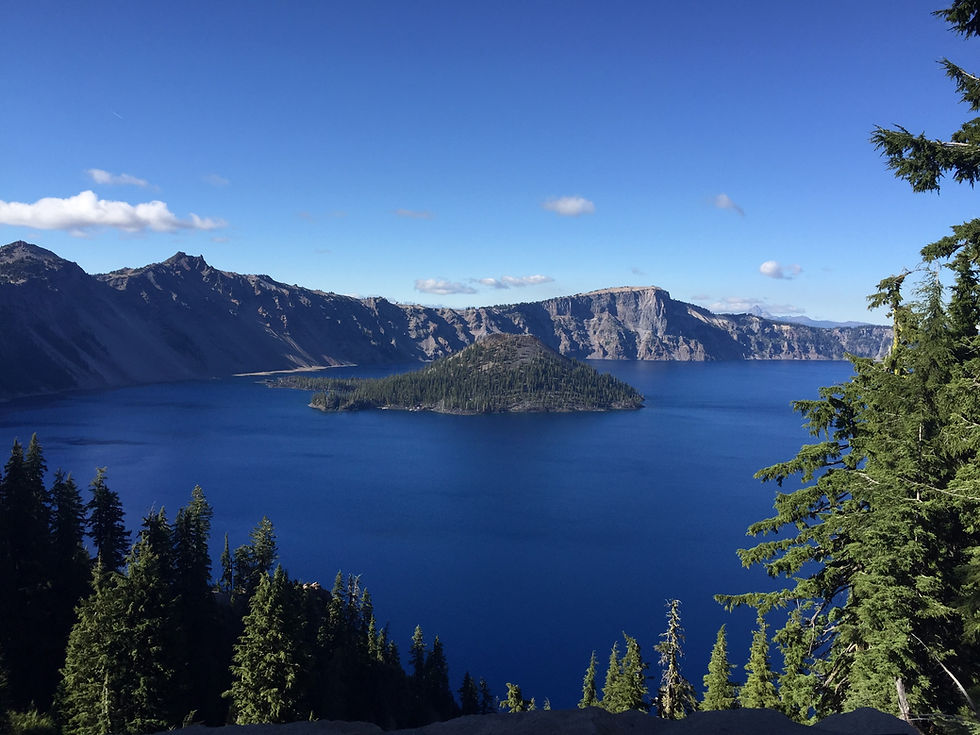
One of the most stunning and unique parks in America, Crater Lake is nearly 2000 ft deep, formed following the eruption of Mount Mazama 7700 years ago. The deepest lake in the United States, Crater Lake is surrounded by hiking trails around its rim, giving views of Wizard Island, a cinder cone, which you can visit on a ferry during summer.
After arriving in the afternoon, set up camp or stay at a nearby town with a private lodging. Then head into the park and circle the lake on the stunning 33-mile Scenic Rim Drive, with over 30 overlooks to catch sunset! The view after a short 1 mile hike to Discovery Point is one of our personal favourites! Along the route are forests, meadows and Videa Falls, as well as plenty of geological formations that have stood the test of time. For example, stop off at Pinnacles Overlook, where 100 ft tall rock spires have been created from frozen volcanic ash. Pretty cool!

The brilliant blues of Crater Lake underneath the Oregon sky are some of the most mesmerising shades. Here, the remnants of the volcanic history of Mount Mazama can be seen, with the cinder cone of Wizard Island poking out from the calm, reflective waters as a lone ferry takes adventurers to one of the most unusual islands in the world.
Day 10 - Crater Lake NP, OR
After exploring the rim of the lake yesterday, get a different view from a little further afield! Just off the southeast side of the lake lies a small volcano, Mount Scott. Park at the trailhead on the side of Rim Drive, ascending pretty sharply, gaining 1200 ft over the course of 2.1 miles. The view from the top allows you to see even more of the lake, and is one of the best in the park! Head back down the same way, on a hike that will probably only take you a few hours.
After, you can grab a drink over at Crater Lake Lodge, and if you want to then hike the other direction, down to the shore, then Cleetwood Cove Trail is the best place to do this! Enjoy one more calm sunset and make the most of your surroundings! It might be a while until you find another lake quite like it!

Pastel colors illuminate the cliffs of the eastern half of Crater Lake, as the unique, sharp peak of Mount Thielsen cuts into the sky in the distance
Day 11 - Redwood National Park, CA
A series of small state parks intertwined amongst the main national park itself, Redwood celebrates the towering trees on the coast of California! Often shrouded in mist, the park will feel very different to the open air and water of Crater Lake! It's about a 4 hour drive to Crescent City and nearby Jedediah Smith State Park, where you can hike one of Redwood's best preserved forests on the Boy Scout Tree trail.
Slowly make your way down US 101 in the afternoon and enjoy the viewpoints. Klamath River Overlook is particularly impressive. See the mouth of a river which has run for 250 miles, all the way from a series of rivers and lakes just south of Crater Lake! It's around 1 mile from the road down a steep trail, but it's a great vista! Other things you can tick off in Redwood today includes wildlife spotting in Elk Meadow, hiking the Trillium Falls trail, tidepool at Endert's beach or False Klamath Cove. Camp at Gold Bluffs Beach, the only beach campground in the park, or stay at View Crest Lodge just south of the national park.
Day 12 - Redwood National Park, CA
The three tallest trees in the world live in the park, so today is all about staring up and realising how small we are in this world! Hike Stout Grove, or for a half day event, apply for a permit to hike Tall Trees Grove. Home to Libbey Tree, this used to be the tallest tree in the world before a storm broke it's top in 1989. Take your time walking the trails, with what can be a relatively slow paced day hike wise. A trip to Kuchel Visitor Center is also worthwhile, to learn about the history of Redwoods and the park in various exhibits.
If you have time, feel free to have a snooze on one of Redwoods beaches, before driving the coastal road again to Redwood Creek Overlook, probably the best place to watch sunset in the park. But if you fancy a trip into civilisation after all these parks, the city of Eureka, which features an old town, various street art, and Sequoia Zoo!


While the park is dominated by some of the biggest creatures on Earth, it's not just trees that you can find in Redwood. Including 37 miles of coastline, grassland hills and dense meadows, there is plenty to see and learn about, understanding this unique eco-system and how the various habitats interact in this isolated but beautiful segment of California's northern edge.
Day 13 - Driving to San Francisco, CA
Given the pace of this road trip, this is probably as close to a proper rest day as you can get! Take the morning slow, grab some breakfast, and meander down to San Fran, around 270 miles and 4.5 hours away.
Cross the Golden Gate Bridge on your way into the city, and hopefully the famous fog won't be rolling in as you do, so you can see the skyline! The TransAmerica Pyramid particularly sets the skyline apart from others. The city has a whole host of amazing hotels to stay in, but we recommend Golden Gate Hotel, The Inn at Union Square, or Galleria Park, depending on your budget and choice of location.
Take an evening stroll up to Coit Tower, where you can get an elevator to the top for $10 each, giving panoramic views of the city, including the Golden Gate you crossed earlier, and Alcatraz, on the list for tomorrow!

There are quite a few locations to stop off and see the Golden Gate Bridge on your way into San Francisco. A good spot is the observation deck, or get a wider view from Marin Headlands. Here, one of the most quintessential views of the bridge can be seen, from Battery Spencer.
Day 14 - San Francisco, CA
One of the most famous sights in California's second biggest city is the prison of Alcatraz, converted from a fort on the island back in 1934. Since, it has become one of the most notorious prison's in the country, due to the difficulty of escape. Many prisoners tried, but the cold waters and strong currents of San Francisco Bay means that nearly all of the 36 men to try to escape died or were captured. However, the fate of three of the escaped inmates remains unknown...
After having breakfast nearby at Eight AM, depart for Alcatraz from Pier 33. The tours last around 2.5 hours, and is really a must for any visit! After getting back to dry land, explore the city on a guided tour in a 1970's VW van, with 6 people per van stopping at Fisherman's Wharf, Chinatown and Lombard Street, and passing by many famous houses and photo opportunities! If you'd like to explore the city yourself, use the streetcars, taxis or Ubers if you don't want to have the fuss of driving and parking! Visit Golden Gate Park, view the Painted Ladies, and shop at Union Square. For dinner, consider Seven Hills for an Italian-seafood combo! Grab an early dinner before a sunset catamaran cruise of San Francisco Bay, for many, the highlight of any trip to San Fran! Take in the beauty of this amazing city before you depart for the mountains.


An awesome city in an awesome state, there are plenty of ways to spend a day or two! Make sure to tick off some of the most famous places and views off your list! Alcatraz, Lombard Street and the Painted Ladies all add to the character of a city which had to be almost entirely rebuilt following the enormous earthquake of 1906.
Day 15 - Up to Yosemite National Park, CA
Yosemite was the third national park to be founded, after John Muir and President Roosevelt experienced the beauty of this segment of the Sierra Nevada Mountain range. The drive down to Yosemite Valley will immediately make you see why, as you wind along cliffside roads bordered by sheer rock faces. When you arrive, head straight to Tunnel View. It's one of the most iconic views of Yosemite. El Capitan frames the view to your left, Bridalveil Falls slightly to the right, and Half Dome can be seen down the middle. So few views in the world can provide so many landmarks all at once...
Afterwards, you can explore Yosemite Valley itself, which is easier after orientating yourself from Tunnel View. Stop at the visitor centre to learn how the enormous valley was created, and enjoy some of the small sights of the park. Mirror Lake casts reflections of El Capitan, while the Merced River provides an opportunity to bathe and refresh. But be warned, it's formed of snow melt - pretty chilly!
If you want to stay in the park, you can choose from camping, or one of the few hotels, such as The Ahwahnee, with grand receptions and cozy rooms. Alternatively, If you'd prefer to be just outside of the park which can be a little cheaper, then Rush Creek Lodge is also a great choice!

"But no temple made with hands can compare with Yosemite. Every rock in its walls seems to glow with life...as if into this one mountain mansion, Nature had gathered her choicest treasures" - John Muir
Day 16 - Yosemite National Park, CA
Drive through the dark up to Glacier Point for sunrise. Find a good spot and enjoy the rays cutting across the mountains before the sun itself rises majestically above Half Dome. Keep an eye out while you're there for some of the wildlife enjoying the cooler morning temperatures! Afterwards, drive back into Yosemite Valley and park near the Lower Yosemite Falls Trailhead. One of the more demanding hikes of both the park and this trip, you can reach the top of Yosemite Falls themselves if you feel up for it!
The views are great throughout as you catch snipets of the falls and the valley below. But the real prize is after the switchbacks near the summit, where you can get up close to the Upper Falls and really appreciate the power of the water as it rushes past! This hike will likely take at least five hours, but for many it takes longer. If you can, try and aim to get close to the top before the temperature gets too warm. The hike (and subsequent recovery) will take up most of your day, so plan accordingly and try not to squeeze too much in the afternoon.

Yosemite Falls thunders past you as you hike to its breaking point. You only truly realise how high up you'll climb after seeing a viewpoint like this!
Day 17 - Yosemite to Death Valley National Park, CA
The legs will probably be a little shaky after yesterday's mega hike! But you may wish to hike up to Vernal and Nevada Falls along the Mist Trail, a very beautiful part of Yosemite! As you can make it an out-and-back trail too, you can literally turn around whenever you've had enough, with the way back down naturally easier than going up.
Around lunchtime, head out of the park east along Tioga Road to Tuolumne Meadows. One of the highest elevation meadows of the Sierra Nevada, the Tuolumne River meanders through, supporting a host of wildlife and plants! The Tioga Road itself is a 47-mile scenic drive which gives you views that the majority of visitors to Yosemite don't see. The road is only open from late May till October or November depending on weather conditions and snowfall, so bear this in mind if you want to head east. Olmsted Point is especially worth checking out, with the peak of Half Dome visible - although the angle makes it look quite different!
Eventually you'll reach a T-junction near Mono Lake, which is the main part of Mono Basin Scenic Area. It's a pretty massive salt lake that has no rivers flowing off of it, with the salts coming from the runoff of dirt and minerals from the surrounding rocks. Head south on US 395 towards Death Valley NP, taking a little detour at Mammoth Lakes to stop at Minaret Vista, with jagged mountain peaks cutting into the sky. After a few more hours driving through the arid valley between the Sierra Nevada and Inyo Mountain ranges, you'll head into Death Valley National Park close to sunset. Arrive shortly after in Stovepipe Wells, a small town with accommodation for the night!


There may not be a 'stand-out' moment of the day, but the change in scenery you'll experience is probably equally as cool. Start at the high alpine meadows of Tuolumne, before descending into dusty valleys. The salt of Mono Lake creates tufa towers, and the arid landscape continues into Death Valley, the hottest place on earth.
Have a closer look at some of California's massive national parks!

%20Kayden.jpg)

Day 18 - Death Valley National Park, CA
Death Valley is actually the largest national park in the Lower 48, being an incredible 4 times bigger than Yosemite! And I bet that felt pretty big when you were hiking and driving around! It contains Badwater Basin, the lowest point in the USA, an eerie sounding 282 ft below sea level...

You can view the basin from Dante's View, on the crest of the Black Mountains that run through the park, which looks particularly beautiful in the early or late light of the day. Zabriskie Point is also impressive, with rock formations formed by earthquakes and water flow millions of years ago. Like Dante's view, it's also just a small walk from the car. Make sure to stop at the visitor center at Furnace Creek to talk to the rangers, and gain a real appreciation of the uniqueness of this park!
Death Valley is quieter during the summer when you'll likely take on this road trip, but this is because of the soaring temperatures, with the average high in July and August being around 115F! So take extra care, with plenty of water, sunblock, and a reliable car, and avoid any sort of hiking during the middle of the day.
The badlands from Zabriskie Point stand in front of the Panamint Mountains, and you can also see the salt flats of the valley floor. The geology impresses at all times of day, but the scene is particularly special at sunset.
Day 19 - Joshua Tree National Park, CA
The last long drive of the trip, Joshua Tree will surely give you the Southern California vibes you expect from nearby LA - pink glowing skies, desert, and a slightly tropical edge. This will be your 8th and final national park checked off on this awesome trip down the Pacific Coast and the western states of America. The park is named after the Joshua Tree, a prickly plant that resembles a small tree, and is primarily native to the Southwestern USA, thriving in the valleys of the Mojave Desert in this part of Cali.
There are a couple of towns bordering the park, namely Twentynine Palms and Yucca Valley, so there's plenty of cute, small houses and retreats around! If you can get an early check in, cook a small lunch before heading into the park for the afternoon.
While significantly smaller than Death Valley, Joshua Tree is still pretty huge. Bigger than the state of Rhode Island in fact! Much of the park is accessible only by 4x4. So let's do that, with an afternoon off-road Jeep 4x4 tour! If you're in the park from October thru May, you can go on a 1.5 hour guided walking tour of Keys Ranch, as park rangers tell the story of a family who tried to make their life in this part of the Mojave Desert.
For the evening, head to Hidden Valley located very close to the Ranch, with some of the park's signature rock piles and trees hosting you for sunset!


Joshua Tree NP is situated at the site where two deserts merge, the higher elevation Mojave, and the lower Colorado. The park is full of the famous trees and rocks, creating a beautiful scene just two hours from central LA.
Day 20 - Joshua Tree NP & Los Angeles, CA
Challenge yourself and take on the rocks of Joshua Tree this morning on a small group beginners rock climbing session! As it's your last morning in a national park, tackle one in a way you haven't done on this trip before! No doubt you'll work up a big appetite, so stop at an In-n-Out on your journey to the City of Angels. This fast food chain prides itself on fresh produce and high staff morale to make delicious burgers, and they do a pretty darn good job! There's hundreds dotted around southern California, so it won't be too hard to find one!
For your afternoon in LA, head straight to Santa Monica to enjoy the beach and the pier. Straight away you'll get a taste of the LA way of life - beach gyms, rollerblading, laid-back. The pier has rides, restaurants, and is the end point for Route 66! On selected evenings during the summer, there's also free concerts! LA is a difficult city to drive around, with the derby between the soccer teams getting the nickname 'El Traffico' as a result. So if you can, pick a hotel or flat not too far from Santa Monica! If you're looking for a luxurious last couple of nights, check out the Santa Monica Proper Hotel. The Ambrose Hotel and Shore Hotel are also great picks!

Twilight at Santa Monica Pier. The area is filled with shops and beach bars, but if you just want to lay on the warm sand and feel the sea breeze, that's okay too! Especially after a long trip like this!
Day 21 - Los Angeles, CA
After 3 states, 8 national parks and about 2,350 miles, today is the last day of an incredible run down the western coast of the USA. If you want a bit of adrenaline thrown into the day, visit Universal Studios or Disneyland. Or if you're a big movie fan, walk Hollywood and see the famous sign, before exploring Warner Bros. Studio on a tour! Combine it with a sightseeing and celebrity home open-bus tour to really get the full LA movie star experience!
Head up to the Griffith Observatory, on the south edge of Griffith Park, the largest in the city. An amazing panoramic view of downtown LA is one of the best in the city. Built in 1935, Griffith is the most visited public observatory in the world. There's also telescopes, exhibits and talks, so you can learn all about the amazing world beyond Earth. Enjoy the observatory itself and the grounds, before picking a good spot for the final sunset of your trip!

Pink hues cover the horizon out over the Pacific Ocean, as a couple of flights out of LAX head into the night. The second biggest city in the United States, you can see large swathes from Griffith Observatory and park, with the skyline of downtown LA standing proudly in the centre of the view.
Got a taste for the Western US? Explore some more with these road trip itineraries!


